On this page
A closer look
Adsorption, not absorption
Separating two terms makes the mechanism much clearer.
- Absorption: a substance gets taken into the inside of a material. It can involve a chemical change
- Adsorption: a substance sticks to the surface of a material. It's a surface phenomenon
What silica gel does is adsorption. The water molecules are simply stuck to the surface of the silica gel, and the silica gel itself doesn't change.
That's why heating it to drive the water molecules off returns it to its original state. This is the reason it can be regenerated.
By contrast, quicklime (calcium oxide), which is also used as a desiccant, reacts with water and becomes a different substance, calcium hydroxide. Because that's a chemical change, it can't be undone. That's why quicklime desiccants are single-use.
Desiccants that adsorb can be regenerated; desiccants that chemically react can't. That difference is what defines silica gel's character.
Pores rack up surface area
If something holds molecules on its surface, the more surface area it has, the more it can take in.
Silica gel is porous. Each bead looks like it's just a few millimeters across, but inside are countless fine pores, and the walls of all those pores count as surface.
Thanks to this structure, a tiny bead has an enormous surface area. That's why it can take in a lot of water relative to its apparent size.
Activated carbon works on the same principle. According to the Japan Kairo Industry Association (the trade group for disposable hand warmers, known in Japan as kairo), the activated carbon in disposable hand warmers adsorbs oxygen from the air and raises the oxygen concentration, which speeds up the rusting of the iron.
Silica gel grabs water vapor; activated carbon grabs oxygen and odor molecules. They target different things, but the principle, "stick molecules to a porous surface," is the same.
Humidity decides how much it takes in
How much water silica gel takes in depends on the humidity around it.
Recall the Japan Meteorological Agency's definition:
Dew point temperature: the temperature at which relative humidity reaches 100% when the air is cooled while its water vapor pressure is held constant.
The amount of water vapor in the air and the amount of water molecules adsorbed on the silica gel's surface are in balance. When humidity is high, more is adsorbed; when humidity is low, less is adsorbed.
So if you put silica gel in a low-humidity environment, it releases water on its own. In a sealed container, it reaches balance once the humidity inside drops to a certain low level, and it doesn't take in any more after that.
This is also what it means that it "doesn't absorb endlessly."
Heating regenerates it
Regeneration can be explained by the same balance.
When heated, the adsorbed water molecules gain thermal energy and break away from the surface. On top of that, warmer air can hold more water vapor, so the released molecules escape into the air.
When it cools down, it settles into a new balance with less adsorbed water. That completes the regeneration.
Typically, people heat it over low heat in a frying pan or warm it in an oven at around 100–150°C (212–302°F). The right temperature varies by product, and the type called Type A is sometimes said to need 150°C (302°F) or higher.
A microwave is not recommended. Silica gel may have adsorbed molecules other than water vapor, and sudden heating can cause unexpected reactions. There's also a risk of hot spots melting the container or starting a fire.
Blue silica gel shows its condition by color
You may have seen silica gel with blue beads mixed in.
Those contain cobalt chloride, which is blue when dry and turns pink when it absorbs water. It's a way of letting you see by color that the gel "can't take any more."
When you regenerate it by heating, the pink goes back to blue. It's a clever indicator that lets you visually confirm the regeneration worked.
However, concerns have been raised about cobalt chloride being harmful, and more and more products are switching to other indicators (such as orange-to-green).
Keep food-packet gel for food
Here's a practical caution.
Silica gel from snack or nori (seaweed) bags can be regenerated and reused. But it may have adsorbed odors and oils from the food.
It doesn't only adsorb water. It picks up odor molecules too. So if you take silica gel that was used with food and use it for something else (like keeping a camera dry), it may transfer those smells.
The safe approach is to keep separate gel for each use.
Porous materials all around us
Lining up things that work on the same principle shows how versatile a porous structure is.
- Silica gel: adsorbs water vapor (desiccants)
- Activated carbon: adsorbs oxygen and odor molecules (deodorizers, water filters, hand warmers)
- Zeolite: adsorbs water and specific molecules (detergents, deodorizers, catalysts)
- Diatomaceous earth: adsorbs water (bath mats, coasters)
When a diatomaceous earth bath mat soaks up water and then dries if you just leave it, that's the same balance of adsorption and release. It works on the same logic as a reusable desiccant.
Related reads
What the video says

You know those little desiccant beads that come in snack bags and sushi roll containers? They're actually not single-use.

A desiccant is really a bunch of beads riddled with countless tiny holes. Those holes pull in water molecules and trap them inside.

Once every hole is full of moisture, the bead can't take in any more. That's what looks like the desiccant being "used up."

But if you heat it gently in a frying pan or an oven, the trapped moisture evaporates and the beads go back to being empty.
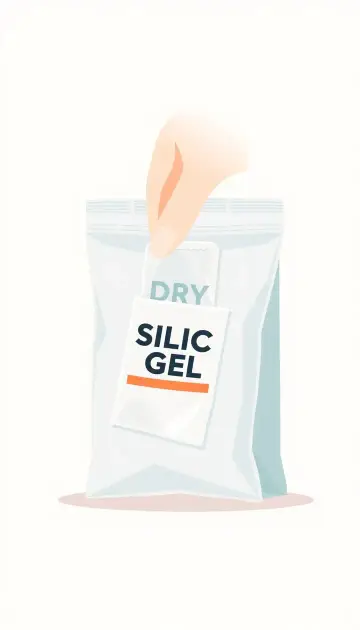
So as long as you dry it out, a desiccant can be reused again and again. It's actually an eco-friendly little item.
Sources
- 気温、湿度に関する用語(予報用語)Japanese“Terms related to temperature and humidity (forecast terminology)”Japan Meteorological Agency
- 使いすてカイロについて(活性炭による酸素の吸着について)Japanese“About disposable hand warmers (on oxygen adsorption by activated carbon)”Japan Kairo Industry Association
Spotted a mistake in the article or the translation? Let us know.
Report an error (contact form in Japanese, opens in a new tab)