On this page
- A closer look
- Inside the oven, two different kinds of cooking happen at once
- The outside hardens because the water leaves and the temperature rises
- The inside is fluffy because the starch gelatinizes
- Without bubbles, there's no fluffiness
- Fresh-baked is special because the water hasn't moved yet
- What it takes to get crisp outside and fluffy inside
- Related reads
- What the video says
- Sources
A closer look
Inside the oven, two different kinds of cooking happen at once
Before baking, the dough is uniform. Its moisture and temperature are about the same everywhere. Yet over a few dozen minutes of baking, it splits into two completely different materials.
The key is where the water can escape.
The surface is directly exposed to hot air. Any steam that forms there can head straight out, so the surface keeps losing water. Once the water is gone, the temperature climbs past 100°C (212°F) and keeps going, reaching 150°C (302°F) and 180°C (356°F).
The inside doesn't work that way. Because it's surrounded by dough, the steam can't get out and stays trapped. As long as there's water, the temperature stalls near water's boiling point—around 100°C.
In the same oven, the surface hits 180°C while the center stays at 100°C. That temperature gap creates two different textures.
The outside hardens because the water leaves and the temperature rises
The crust is the part that gets exposed to high heat after its water has escaped.
With so little moisture, it simply dries out and hardens. That crackly feel when you break the crust of a fresh baguette is the sound of a layer whose moisture has dropped to just a few percent.
And once it passes 150°C, a different reaction kicks in: the Maillard reaction, in which sugars and amino acids react to form brown pigments and aroma compounds. Bread's golden-brown color and that "fresh-baked bread smell" only come about in this temperature range.
Inside, where water remains, the temperature can't go past 100°C, so the Maillard reaction doesn't happen. That's why the inside stays pale and doesn't develop that toasty flavor. The fact that only the outside browns is basically the temperature boundary made visible.
The inside is fluffy because the starch gelatinizes
The softness of the crumb (the inside) comes from changes in the starch.
Raw wheat-flour starch exists as hard granules. Given both water and heat, they absorb water, swell, and loosen in structure into a paste-like state. This is called gelatinization. "Microscopic and Macroscopic Observation of State Changes Accompanying Gelatinization in Starch Granule–Water Systems," published in the Journal of Cookery Science of Japan, tracked this change at both the microscopic and macroscopic levels.
Gelatinization requires water. Since the inside still has moisture, gelatinization proceeds there and the crumb turns soft. At the surface, the water leaves first, so it gets hot before it can fully gelatinize.
"The Relationship Between Bread Texture and Bubble Structure," also in the Journal of Cookery Science of Japan, concludes that within the bubble walls, the physical properties and moisture content of the starch gelatinized during baking determine the texture. Bread's fluffiness depends on both a structure (the bubbles) and a material (the gelatinized starch).
Without bubbles, there's no fluffiness
The other factor is the air bubbles in the dough.
Yeast gives off carbon dioxide as it ferments, creating countless tiny bubbles in the dough. In the oven, this gas expands while steam is also produced, and the bubbles grow rapidly.
What surrounds those bubbles and holds their shape is a film of gluten. A study from the Japan Society of Home Economics, "Effects of Gluten Protein Composition on Breadmaking," baked bread with varying ratios of gliadin and glutenin and measured specific volume, crumb texture, and degree of gelatinization. It reported that a higher proportion of gliadin suppressed starch gelatinization, while a higher proportion of glutenin promoted it.
In other words, protein composition affects texture by way of starch gelatinization. This chain of effects is why the type of flour—high-protein bread flour versus low-protein cake flour—makes a difference in texture.
Fresh-baked is special because the water hasn't moved yet
Here's where it connects to everyday experience. Fresh-baked bread is crisp outside, but after a few hours it goes soft.
The reason is that water moves around inside the bread.
Right out of the oven, the crust is dry and the crumb is moist. Left alone, that difference shrinks. Moisture from the inside migrates outward, and the crust becomes damp and pliable.
That's why the crust on a loaf of sandwich bread gets soft if you leave it in its bag. When the bag is sealed, the water can't escape the bread, so its only place to go is the crust.
Toasting, on the other hand, brings it back. It drives off the surface water again and raises the temperature, restoring something close to a fresh-baked crust.
By the way, the common advice that you shouldn't slice bread right out of the oven is also about moisture. Just after baking, the moisture in the crumb is still unevenly distributed and the structure is unstable, so it squashes easily when cut. Let it cool a bit first and it will slice cleanly.
What it takes to get crisp outside and fluffy inside
To sum up, this texture comes from the following combination:
- High heat, short time: Drive off surface water quickly while leaving water inside
- Add steam: Steam early in baking delays the surface from setting, letting the dough rise well
- Proper fermentation: The number and size of bubbles determine how light the crumb is
- Eat it fresh: Before the moisture has migrated
Bakery ovens have a steam function to "delay the moment the surface sets." Misting the dough with a spray bottle in a home oven serves the same purpose. However, some point out that too much water advances gelatinization at the surface and makes the crust thick and hard. Getting that balance right is where a baker's skill really shows.
Related reads
What the video says
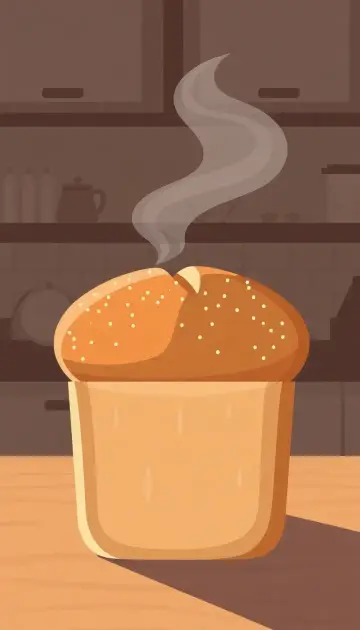
Fresh-baked bread has a crisp outer crust and a fluffy inside, right? It's actually a curious thing that happens during baking, even though it's all the same dough.
When bread bakes, the outside is directly exposed to the hot oven, and its moisture keeps evaporating. That's why it ends up dry and crisp.
Meanwhile, the center of the loaf is surrounded by dough, so heat reaches it more slowly. The moisture stays trapped and turns to steam, puffing the bread up. That's where the fluffiness comes from.
In other words, the outside dries and firms up, while the inside stays moist and soft. The contrast created by this temperature difference is the secret behind that delicious texture.
Sources
- パンの食感と気泡構造の関係Japanese“The Relationship Between Bread Texture and Bubble Structure”Journal of Cookery Science of Japan, Vol. 49, No. 4
- グルテン構成タンパク質組成が製パンに与える影響Japanese“Effects of Gluten Protein Composition on Breadmaking”Abstracts of the Annual Meeting of the Japan Society of Home Economics
- デンプン粒~水系の糊化にともなう状態変化の微視的および巨視的観察Japanese“Microscopic and Macroscopic Observation of State Changes Accompanying Gelatinization in Starch Granule–Water Systems”Journal of Cookery Science of Japan, Vol. 38, No. 1
Spotted a mistake in the article or the translation? Let us know.
Report an error (contact form in Japanese, opens in a new tab)