On this page
A closer look
Rice is 15% water; cooked rice is 60–65%
Put the numbers side by side and the difference becomes obvious. Here's what Japan's Ministry of Agriculture, Forestry and Fisheries says in its "Cooking Properties of Rice":
We Japanese routinely take non-glutinous rice (about 15% water), add water, and heat it to make cooked rice with about 60–65% water. This process is called rice cooking.
The grain itself is 15% water. Cooked, it's 60–65%. That's more than four times as much.
And cooked rice can go bad in half a day in summer. It's the same ingredient, yet how long it keeps changes by orders of magnitude. The only difference is the water.
Microbes can't multiply without water
Why does the amount of water make such a huge difference? A glossary entry from the Japan Society of Refrigerating and Air Conditioning Engineers explains that water comes in two kinds:
Water consists of free water, whose molecules can move around freely and which microorganisms can use, and bound water, which is attached to other components in the food (such as proteins and carbohydrates) by hydrogen bonds, so that its molecular motion is restricted and it cannot be used by microorganisms.
Free water and bound water. Microbes can only use free water.
The measure of this proportion is called water activity.
In 1957, Scott proposed water activity as an indicator of the proportion of free water in food, and showed the relationship between water activity and the growth limits of microorganisms.
It's even used in legal standards.
Because water activity indicates the growth limit (lower limit) of food microorganisms, in Japan it is used in the manufacturing standards under the Food Sanitation Act for pressure- and heat-sterilized packaged foods, soft drinks, fish paste products, and meat products.
The important thing is that it's "water activity," not "water content." The 15% of water inside a grain of rice is bound up with starch and protein, so microbes can't freely use it.
15.0% is a number set by official standards
This moisture figure isn't a rule of thumb; it's a standard. Here's how the Ministry of Agriculture, Forestry and Fisheries describes the JAS (Japanese Agricultural Standard) for milled rice:
This is the moisture value of the milled rice. It is measured using one of the methods specified by JAS: the atmospheric-pressure oven-drying method, a method using an electric moisture meter, or a method using a near-infrared analyzer.
And it spells out the link to storage:
The moisture value affects how well milled rice keeps at room temperature and whether mold and the like develop.
The JAS standard value is:
15.0% or less
Not "around 15% as a guideline," but an upper limit of "15.0% or less." A number meant to prevent mold is written right into the standard.
But you can't dry it too much, either
That said, lower isn't always better. When rice is dried after harvest, it's considered ideal to bring the final moisture to 14.5–15.0%.
Dry it too much and you get more cracked and broken grains when it's milled, and the taste suffers too. This narrow band is the range where both shelf life and quality can be achieved.
On advances in storage technology, the ministry's materials say:
However, as rice storage technology has advanced and the moisture of rice is managed at about 15–16% throughout the year, there is less need to pay attention to how much water to add.
It used to be common knowledge that you adjusted the water for new-crop rice versus older rice, but now that moisture can be controlled during storage, there's less need for that. Rice kept in low-temperature warehouses is said to stay at around 15 ± 0.5% moisture.
It doesn't "rot," but it does "deteriorate"
This is a distinction worth making. Rice doesn't rot, but it does change.
- Oxidation: Fats in the grains oxidize and cause the stale smell of old rice
- Drying out: Left at room temperature for a long time, rice loses moisture and doesn't taste as good
- Insects: Pests like rice weevils can live even in dry rice
- Mold: If rice absorbs humidity and its moisture rises, mold will grow
The same document also addresses how to handle old rice:
When rice has been stored for a long time and become old rice, washing it by rubbing can remove oxidized fats and the like from the surface of the grains, so an improvement in taste can be expected.
The reason old rice tastes better when you wash it thoroughly is that you're scrubbing off the oxidized fats on the surface. You don't get this effect with no-rinse rice or gentle rinsing.
The keys to storage: moisture and odors
Once you know how rice goes downhill, your storage priorities fall into place.
Avoid moisture. Under the sink is a poor spot because of condensation on the water pipes. Put rice in an airtight container and keep it somewhere cool. In summer, the fridge's vegetable drawer is a strong option.
Avoid odors. Rice bags have small holes so the rice can breathe, which lets smells in. Don't keep rice near detergent or kerosene.
Use it up quickly. Milling exposes the surface to air, so oxidation speeds up. Brown rice keeps longer.
Cooked rice suddenly spoils easily because the moment you bring its water above 60%, free water increases and you've created an environment microbes can use. If you want to store it, freezing is the sure bet, since the water freezes and can no longer move around.
Related reads
What the video says
You can leave rice sitting in its bag for a long time, and it just doesn't seem to go bad, right? There's actually a good reason for that.
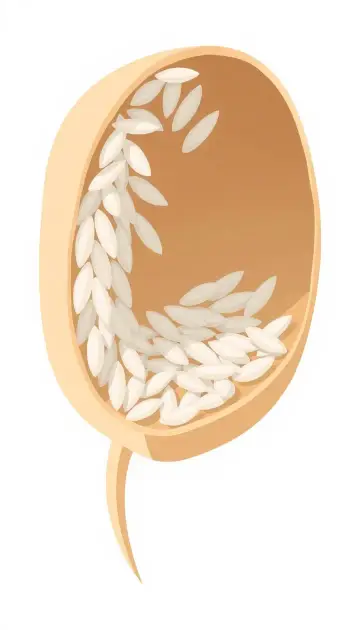
There's actually very little water left inside a grain of rice. When it's this dry, bacteria and mold don't have the water they need to grow, so they can't multiply.
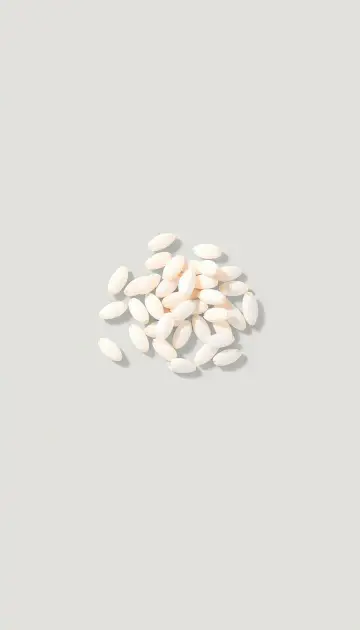
On top of that, the surface of the rice still has a tough, skin-like layer, which acts as a barrier protecting the rice from outside moisture and insects.

So if you keep it away from moisture and store it somewhere cool, rice can stay good for years. In fact, it's not unusual for rice to be stored for 5 or even 10 years as emergency supplies.
Who knew the rice we eat every day had this kind of storage wisdom hidden inside it?
Sources
- 米の調理特性Japanese“Cooking Properties of Rice”Ministry of Agriculture, Forestry and Fisheries (Japan)
- 精米JAS(日本農林規格)についてJapanese“About the JAS (Japanese Agricultural Standard) for Milled Rice”Ministry of Agriculture, Forestry and Fisheries (Japan)
- 水分活性(学会誌「冷凍」用語解説)Japanese“Water Activity (Glossary, journal "Refrigeration")”Japan Society of Refrigerating and Air Conditioning Engineers
Spotted a mistake in the article or the translation? Let us know.
Report an error (contact form in Japanese, opens in a new tab)