On this page
A closer look
Fish change color by moving pigment around inside their cells
Human skin color is determined by how much pigment the body produces. Fish are different. An explainer from Toho University spells out that difference clearly.
The pigment cells of poikilothermic (cold-blooded) vertebrates and invertebrates also produce pigment substances, but generally they do not secrete them and continue to contain them, so they are often called "chromatophores" to distinguish them from the pigment cells of homeothermic (warm-blooded) vertebrates.
The pigment isn't released outside the cell; it stays inside. That's why simply changing where the pigment sits is enough to change the body's color.
Chromatophores come in different types.
They are called melanophores (black chromatophores) erythrophores (red chromatophores) xanthophores (yellow chromatophores) and they normally exist in the dermis. All of them take a shape with branching processes extending radially, parallel to the plane of the skin, and this seems not unrelated to the fact that, developmentally, they are relatives of nerve cells.
They spread their branches out like a star, and the explainer notes that, in terms of development, they're relatives of nerve cells. When the pigment granules scatter out to the tips of these branches, the color looks darker; when they gather at the center, it looks paler. That's the basic mechanism of color change.
Some chromatophores don't contain pigment at all.
In addition, cells that contain no pigment but contain crystals that reflect light well, producing color through the reflected light, are also called chromatophores.
The metallic sheen of goldfish and the shine of silvery fish come from these. Instead of pigment, crystals reflect light to create the color.
Fish use their eyes to measure how bright the background is
The most interesting part is that the trigger for color change is vision.
This motility is controlled by the nervous and endocrine systems, but the direct stimulus is external light received through the eyes.
So what are the eyes looking at?
Where light shines, the photoreceptor cells in the retina of an animal's eye directly receive the incident light coming from above with the ventral retina. Light reflected from the background is received by the photoreceptor cells of the dorsal retina; if the background is white, a considerable amount of light will be reflected, and if it is black, almost none will be.
Light coming from above is received by the lower part of the retina, and light bouncing up from below is received by the upper part. Then:
Based on information carried to the central nervous system via sensory nerves from the photoreceptor cells in the ventral and dorsal retina, the ratio of incident to reflected light is judged, and the animal recognizes how light or dark the background it is in is.
The fish takes the ratio of light from above to light reflected from below. Using this ratio, it can tell whether the bottom is white or black regardless of whether the overall surroundings are bright or dim. It's a clever system.
And what's the result?
The result is a color and pattern very similar to the color of the background, which has a concealing effect. It is easy to imagine that color change is an extremely important strategy for the animal's survival.
A goldfish placed in a tank with a black bottom turns darker, and when moved to a white container its color gets paler. That's this background adaptation at work. It also makes sense to think that the same circuit is at work when goldfish kept outdoors in the sun become more deeply colored.
Short-term changes come from nerves, long-term changes from hormones
There are two pathways that move chromatophores. The fast one is the nervous system.
Nervous control of chromatophores is especially pronounced in teleost (bony) fishes. Fish chromatophores are under single innervation by the sympathetic nerves.
Substances released from the ends of sympathetic nerves move the pigment.
The adrenergic transmitter released onto the chromatophore surface from the peripheral ends of sympathetic postganglionic fibers is mainly norepinephrine (NE)
Because these are sympathetic nerves, color changes when a fish is startled or excited also run through this same circuit. When you scoop up a fish and startle it and its color goes pale, that's a nervous response.
The other pathway is hormones.
The intermediate pituitary hormone (α-MSH) affects chromatophores of poikilothermic vertebrates in general, and generally disperses pigment granules and the light-scattering organelles inside leucophores (white chromatophores).
There's also a hormone that works in the opposite direction.
At low concentrations, as its name suggests, it induces the aggregation of melanin granules (black pigment granules). When a fish is placed on a white background, secretion of MCH from the posterior lobe is also promoted.
MCH (melanin-concentrating hormone) gathers the black pigment together, while MSH scatters it. It's like having a separate gas pedal and brake.
Over a long time, even the number of cells changes
This part may be the answer to the fishkeeping experience that "goldfish get deeper colors in the sun."
MSH is involved not only in physiological color change but also in morphological color change when a fish is adapted to a background over a long period. There is an experimental result in which α-MSH was continuously administered to Mozambique tilapia for more than 10 days, and regardless of background color, the number of melanophores increased and they also grew larger.
After more than 10 days, the number and size of the chromatophores themselves increased. In other words, long-term change goes beyond the stage of "moving pigment around" and enters the stage of "adding more cells."
If a state of physiological adaptation to a certain background color continues for a number of days, it is conceivable that morphological changes may also occur. When MSH binds to its receptor, that information is of course delivered to the mechanochemical system of pigment granule movement, but it is presumably also transmitted to the nucleus at the same time, influencing things such as gene transcription regulation.
When a goldfish that was kept outdoors is moved indoors, its color doesn't revert in a few days but fades over several weeks. This is thought to be because two time scales overlap: short-term pigment movement and long-term cellular change.
But it depends on the kind of fish
It's only fair to point this out: the mechanisms of background adaptation differ from species to species, and there isn't yet a unified explanation.
There are reports that when rainbow trout or eels are adapted to a black background, blood MSH levels rise, but in flounder-type fish there was no change. In actual background adaptation, there may be a hormone-dependent type (the former) and a nerve-dependent type (the latter).
So far, it seems that some fish change color through hormones and others through nerves.
On top of that, the light-reflecting type of chromatophore is a separate case.
Iridophores of the blue damselfish type, which produce structural color through so-called non-ideal multilayer thin-film interference, are hardly controlled by hormones at all, and are operated almost exclusively by nervous control. These structural colors are often used for communication among individuals in a school, which may be why rapid color change is required.
Nerves for when color needs to change quickly, hormones for gradually matching the surroundings. The view is that there seems to be a division of labor.
As for goldfish specifically, studies that quantitatively show how water temperature and sunlight change their color are hard to find, at least in publicly available Japanese-language materials. The mechanism, chromatophores moving and multiplying, is well established, but numbers like "at this temperature, over this many days, the color changes this much" still remain in the realm of hobbyists' practical experience.
Related reading
What the video says

If you keep a goldfish for a long time, its bright red color may gradually fade. This actually isn't a disease. It's a natural change.
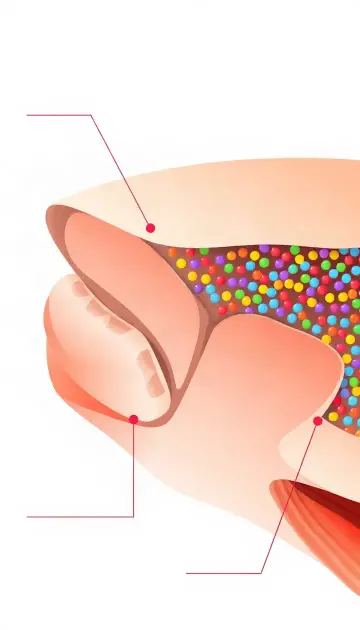
A goldfish's body color comes from tiny grains in its skin called pigment cells. The number and arrangement of these grains change with age and environment.

When a goldfish gets little sunlight or stays in cold water for a long time, its pigment cells become less active, and its body color turns paler and more whitish.

On the other hand, it's also known that when goldfish grow up with plenty of sunlight, their pigment cells become more active, and their red and gold colors can become deeper and more vivid.

In other words, a goldfish's color isn't just something it's born with. It changes little by little as everyday conditions add up.
Sources
- 魚の体色変化の不思議を探る(1.色素胞の種類と運動性)Japanese“Exploring the Wonders of Fish Color Change (1. Types and Motility of Chromatophores)”Toho University Virtual Laboratory
- 魚の体色変化の不思議を探る(2.色素胞運動の神経による制御)Japanese“Exploring the Wonders of Fish Color Change (2. Nervous Control of Chromatophore Movement)”Toho University Virtual Laboratory
- 魚の体色変化の不思議を探る(3.色素胞運動のホルモンによる制御)Japanese“Exploring the Wonders of Fish Color Change (3. Hormonal Control of Chromatophore Movement)”Toho University Virtual Laboratory
Spotted a mistake in the article or the translation? Let us know.
Report an error (contact form in Japanese, opens in a new tab)