On this page
A closer look
Hair has a moisture level it's meant to have
Hair is a fiber made of bundled proteins (keratin). When it's healthy, it contains roughly 11–13% water.
That water isn't excess. It's what keeps hair supple.
When the moisture drops, hair:
- Gets stiff: It bends less easily and breaks more easily
- Builds up static: There's no longer water to carry the charge away (the same reason static electricity is more common in winter)
- Loses its shine: The surface roughens and scatters light
That's what "dry and frizzy" really means.
Wet hair is swollen
When hair absorbs water, the water gets inside the fiber and makes it swell (this is called swelling).
In that swollen state, the bonds within the fiber loosen. That's why wet hair stretches easily and changes shape easily. Fixing bedhead with water takes advantage of this property.
At the same time, the cuticle (the scale-like layer on the surface) tends to open up. When it's open, the inside of the hair is exposed to the outside world.
Wet hair is vulnerable, both physically and chemically.
Too much hot air blows away even the water you need
The point of drying is to remove the extra water sitting on the surface and between the fibers. The 11–13% moisture that belongs inside the hair has to stay.
But if you keep blasting hot air, it removes water without distinguishing between the two.
Recall the Japan Meteorological Agency's definition:
Dew point temperature: The temperature at which relative humidity reaches 100% when the temperature is lowered while keeping the water vapor pressure constant.
As temperature rises, the maximum amount of water vapor air can hold goes up. So hot air can take on more water vapor than cool air. A stronger drying power also means a stronger power to overdo it.
The hot air from a hair dryer can exceed 100°C (212°F) at the nozzle. If you hold it close to your hair and keep it there, it will drive off even the moisture your hair needs.
Once the cuticle curls up, it doesn't go back
The troublesome part of heat damage is what happens to the surface.
The cuticle overlaps like fish scales to protect the inside of the hair. When heat dries it out, it curls back or peels up.
A curled cuticle:
- Scatters light → hair loses its shine
- Lets internal moisture escape more easily → hair dries out even more
- Catches on neighboring hairs → hair feels rough and tangles
What's more, once the cuticle has peeled up, it doesn't return to normal. Hair is made of dead cells, so it can't repair itself.
This is the crucial difference from skin. Even when skin dries out, new cells are produced, but hair stays the way it is until it grows out.
Leaving it wet is bad too
You can't flatly say that "air-drying is gentler," either.
Wet hair has an open cuticle and is vulnerable to friction. If it rubs against your pillow while wet, the cuticle can get physically worn away.
On top of that, a damp scalp is an environment where bacteria multiply easily. Just like laundry dried indoors, the longer it stays wet, the longer bacteria have to be active.
In other words, both "overdrying" and "staying wet" are bad. You need to aim for the middle.
A practical way to dry your hair
Here's the approach that follows from how all this works.
1. Remove water with a towel. This reduces how much water the dryer has to drive off. But don't rub hard; press the towel to soak it up. Wet hair is vulnerable to friction.
2. Keep your distance. At 15–20 cm (6–8 inches) away, the temperature of the air reaching your hair drops significantly. The closer you get, the riskier it is.
3. Keep it moving. Don't keep it aimed at the same spot.
4. Dry from the roots. The ends are thinner and dry first. If you dry the roots first, the ends spend less time overdrying.
5. Switch to cool air when it's about 80% dry. Don't force out the remaining moisture. Cool air has less drying power, so it doesn't overdo it. Plus, cooling helps the cuticle close up.
Looking at it in terms of wettability
The concept of wettability covered in Toyo University's explainer applies to hair, too.
Changes in the shape of a water droplet are expressed by the "contact angle." (omitted) For "water-repellent" surfaces that repel water, the contact angle is large, and for "hydrophilic" surfaces where water spreads out, the contact angle is small.
On healthy hair, the cuticle lies neatly and is coated with oils, so the surface repels water slightly (weakly water-repellent). That keeps too much water from getting inside.
In damaged hair, the cuticle peels up and the surface becomes more hydrophilic. Water gets in easily and leaves easily. That creates an unstable state where hair "swells a lot when wet and quickly turns dry and frizzy when it dries."
Hair treatments work because they artificially restore these surface properties. They coat the surface with oils or a film to limit water going in and out. It's the same idea as the adhesive on a bandage or water-repellent coatings: designing the properties of a surface.
Related reading
What the video says
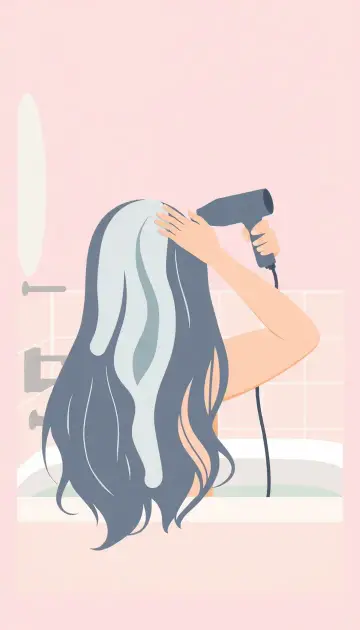
After a bath, a hair dryer is a must for drying your hair. But doesn't it feel like your hair gets a little drier and frizzier every time you use it?
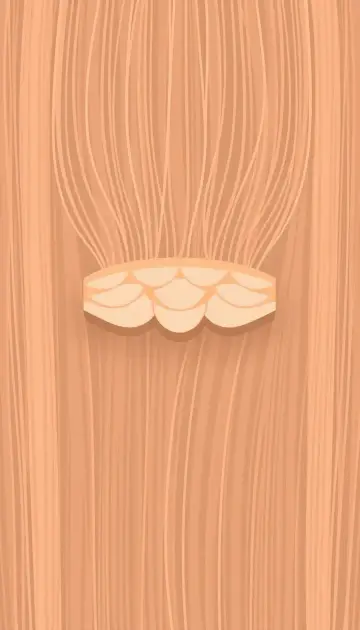
The surface of each hair is covered by a thin, scale-like layer called the cuticle. It's what locks moisture into your hair.
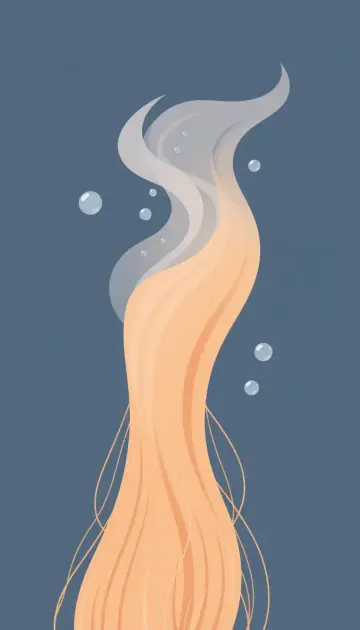
If you hold the dryer too close or blow hot air on your hair for too long, the cuticle opens up and the moisture inside evaporates all at once.
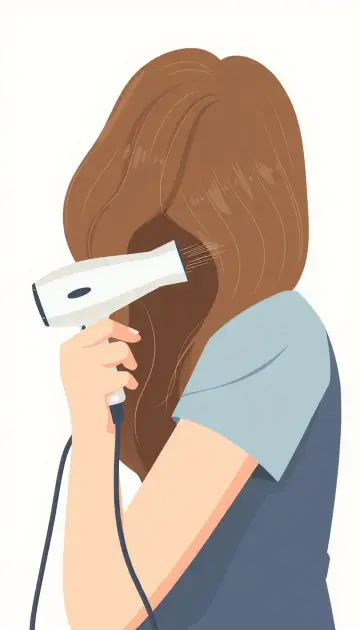
So frizz is really a lack of moisture from overdrying. The trick is to hold the dryer about 20 centimeters (8 inches) away and not keep it pointed at one spot.
Sources
- 表面張力と濡れ性Japanese“Surface Tension and Wettability”Toyo University
- 気温、湿度に関する用語(予報用語)Japanese“Terms Related to Temperature and Humidity (Forecast Terminology)”Japan Meteorological Agency
Spotted a mistake in the article or the translation? Let us know.
Report an error (contact form in Japanese, opens in a new tab)